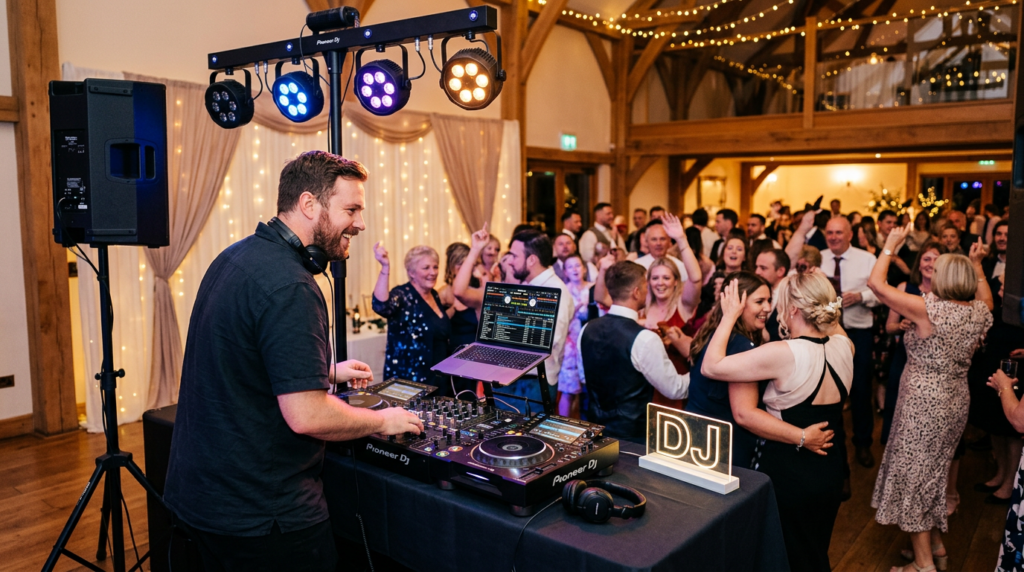
Quick answer: Choose a wedding DJ by matching their style to your crowd, confirming they can handle announcements smoothly, and checking their planning process. Ask for a sample mix, a clear song-request policy, and how they deal with “do-not-play” tracks. Make sure they bring professional sound/lighting, have backup gear, and can provide proof of public liability insurance if your venue asks for it. Get everything in writing, including timings and setup needs.
Start With Style, Not Just a Playlist
A good DJ choice starts with the vibe you want: clubby and high-energy, mixed-era singalongs, or a relaxed background feel that ramps up later. Ask how they read the room and transition between genres without killing the dancefloor. A short sample mix can tell you more than a long song list because you can hear pacing, beat-matching (if that matters to you), and how clean the edits are.
Also check how they handle the “mic” side of the night. Some DJs are confident hosts who can run entrances, first dance cues, and last-song announcements; others prefer minimal talking. Neither is wrong, but it needs to match your plan. If you’re comparing options for wedding dj hire, ask what they need from you (timeline, key names, pronunciations) and how far ahead they like to lock in the running order.
Song requests can make or break the flow, so get specific about rules. A practical approach is: guests can request, the DJ filters for energy and appropriateness, and your “do-not-play” list is followed without on-the-spot negotiation. For example, you might ban an ex’s “song,” explicit versions of certain tracks, or anything with a particular word. Ask how they handle a pushy guest (“We’ll play it if the couple approves” or “We’re keeping to the couple’s plan tonight”) and whether they’ll swap to radio edits automatically.
Questions That Reveal Professionalism Fast
Ask practical questions that expose how prepared they are. What time do they arrive for setup, and how long do they need? A common setup window is 60–120 minutes, depending on the size of the sound system, lighting, room access, and whether speeches need extra mics. Confirm where they set up, whether they need a table, and what power they prefer (some setups run best on a dedicated socket, but venues vary).
Backup planning matters. A typical professional plan includes spare cables, a second playback option (for example, laptop plus USB, or controller plus phone emergency feed), and a way to keep music running if a speaker or mixer fails. Insurance is also a straightforward check: some venues ask for proof of public liability insurance, so ask if they can provide a certificate on request.
Sound limiters are another venue-specific reality. Ask if the venue has a limiter, where it’s measured (often near the dancefloor), and what the DJ does to avoid repeated cut-outs. Common strategies include tuning EQ to reduce low-end spikes, aiming speakers away from the sensor, using more evenly distributed speakers at lower volume instead of one loud pair, and keeping mic levels controlled so announcements don’t trigger the limiter.
A Quick DJ Comparison Checklist
Use this to compare quotes and conversations side-by-side without relying on gut feel:
DJ Comparison Checklist
| What to compare | What “good” looks like | What to clarify |
|---|---|---|
| Style & mixing | Sample mix matches your vibe; smooth transitions; good pacing | Can they cover your genres and clean edits/radio versions? |
| MC skill | Confident but not over-talkative; clear announcements | Who cues entrances/first dance/cake cut; can they pronounce names? |
| Planning process | Structured timeline check-in; request + do-not-play system | How they handle pushy requests; approval method for exceptions |
| Gear & backup | Quality sound; spare cables; secondary playback option | Setup time, space needs, power needs, sound-limiter plan |
| Insurance | Can provide PLI certificate if required | Amount and whether the venue has specific requirements |
| Contract terms | Clear hours, payment schedule, cancellation, substitution plan | Overtime options, what happens if DJ is ill, force majeure wording |
| Quote inclusions | Transparent list of what’s included (mics, lighting, travel) | Extra costs for early arrival, extra rooms, ceremony audio |
Planning Details Couples Forget Until It’s Too Late
Confirm the key moments and who cues them. The DJ should know exactly when to start the first dance track, whether to fade or play the full version, and whether they’re expected to invite guests onto the floor. If you have multiple rooms (drinks reception, dinner, evening), ask whether background music earlier is available and whether it requires a second speaker setup.
Talk about the “awkward” slots: the first 10 minutes after the first dance, the post-buffet lull, and the final 20 minutes. A skilled DJ plans energy waves—big singalongs, then a breather, then a rebuild—so the floor doesn’t empty and stay empty. If you want a last-song moment or a specific finale, share the exact track and timing so it’s not an afterthought.
Noise rules and finish times shape the music choices. If your venue has a hard stop (for example, 11pm), plan the “big hitters” earlier and decide how you want the final announcement handled. If there’s a limiter, agree on a volume approach that keeps the music consistent rather than risking repeated power cuts.
Next steps for your first call or email: send the date and venue, estimated guest count, the vibe you want (plus 10–20 “must plays” and a short do-not-play list), key moments and timings, and practical details like sound limiter info, access times, and where setup is allowed. Ask to see a contract, a public liability insurance certificate (if your venue requests it), and their contingency/substitution policy in writing. If you want local help pulling that together, SpinSisters LTD can help.